I present here my paper on the relation between the pogroms and the Jewish migration.
The migration of one and a half million Jews from the Russian Empire to the United States during the years 1881–1914 is commonly linked to the occurrence of pogroms, eruptions of anti-Jewish mob violence, that took place mainly in two waves in 1881–1882 and in 1903–1906. Although the common perception that pogroms were a major cause for Jewish migration is now questioned by historians, little quantitative evidence exists to support or refute this view.
I construct a new data set that matches hundreds of thousands of Jewish immigrants to their respective hometowns in the Russian Empire over the years 1900–1914, and traces the evolution of migration over the years 1861–1920 using incorporation records of 1,476 Jewish hometown-based associations in New York. Additionally, the locations of hundreds of pogroms that occurred during the two waves are identified. Mapping the pogroms, as well as the yearly migration flows from more than 200 districts provides a first close look into the geographic evolution of the Jewish migration and the way it was affected by pogroms.
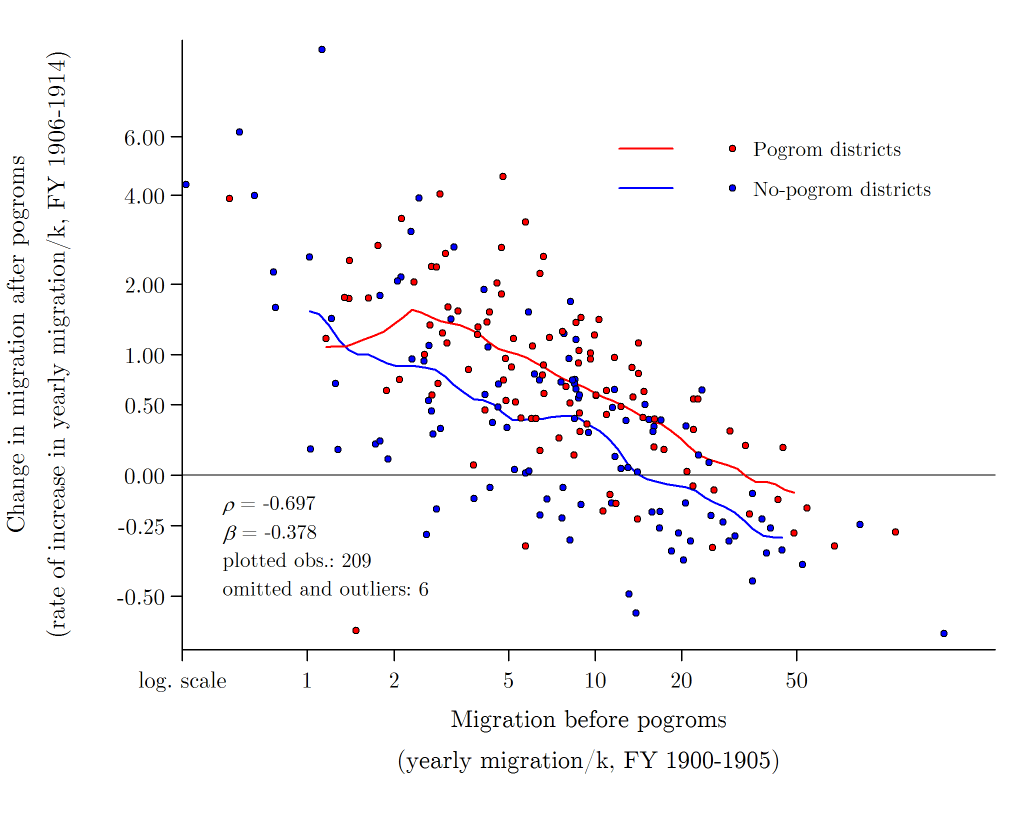
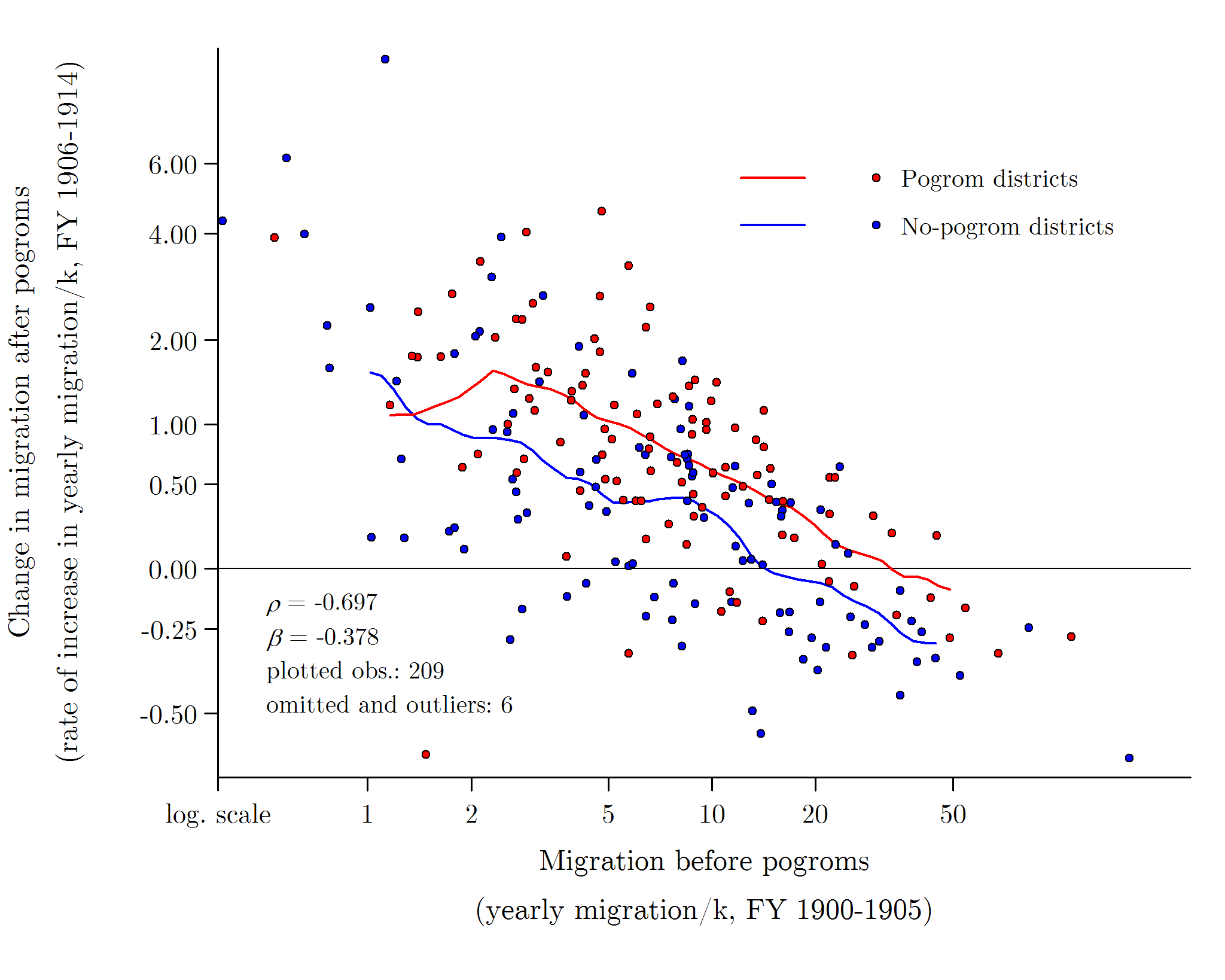
I find no evidence that migration in its earliest stages was caused by the 1881–1882 pogroms; instead, migration after these pogroms continued along a pre-existing spatial trend of migration, and took place in districts that did not experience any violence. The second wave of pogroms, however, increased the rate of migration from the affected districts by at least 10–20 percent. Above all, there was a dominant pattern of convergence in rates of migration across districts driven by a process of spatial diffusion.
I interpret these findings as an indication that neither pogroms nor economic or demographic conditions determined the timing of the beginning of mass migration from each district; instead, migration was chiefly ignited by the arrival of chain-migration networks. Pogroms increased the demand for migration, but victims of the first wave of pogroms could not respond to the greater incentive to migrate because they were not yet personally linked to previous migrants.
These patterns support the diffusionist view of European migration patterns, relating the late arrival of mass migration from southern- and eastern-Europe to slow spatial diffusion of migration networks. The general lesson for the economics of mass migration is that links to friends and relatives do not merely reduce the costs of migration; in certain circumstances they are a necessary condition for migration, their absence creating a bottle-neck delaying the evolution of mass migration by many years and even decades.


 Yannay Spitzer
Leave a comment