Published papers
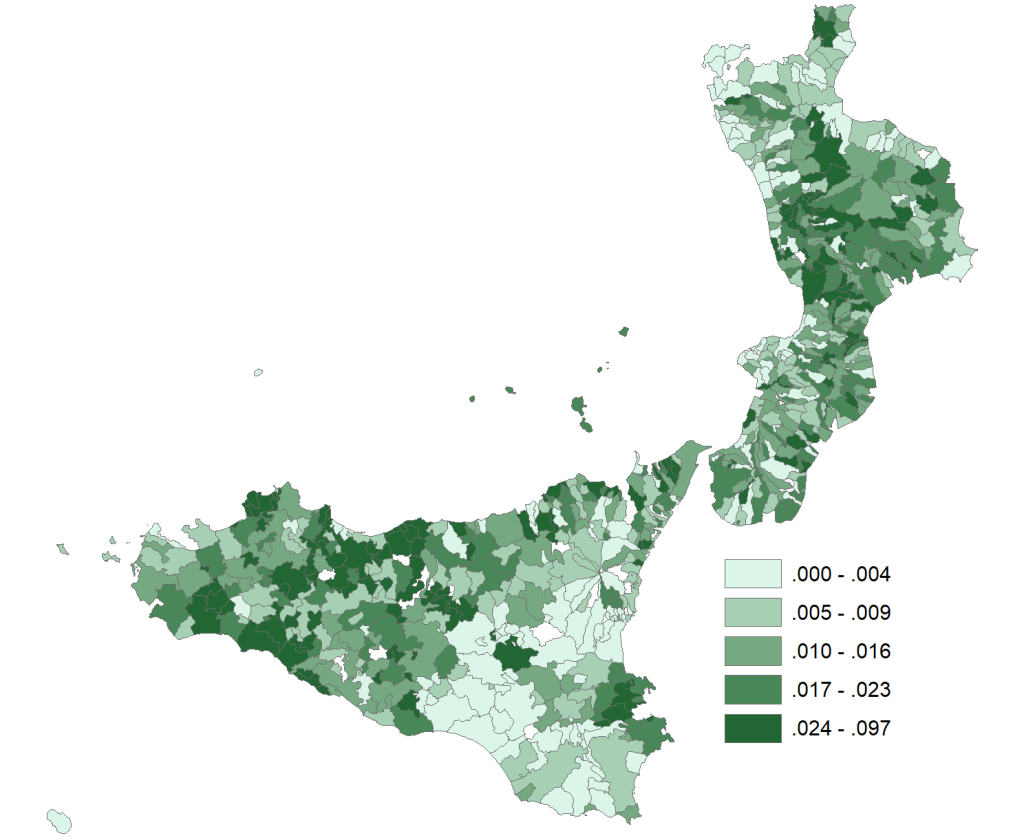
International Migration Responses to Modern Europe’s Most Destructive Earthquake
Messina and Reggio Calabria, 1908
Yannay Spitzer, Gaspare Tortorici, and Ariell Zimran
Journal of Economic History (2025)
abstract
The Messina-Reggio Calabria Earthquake (1908) was one of the most devastatingnatural disasters in modern European history. It occurred when overseas mass emigration from southern Italy was at its peak and international borders wereopen, making migration a readily available option for relief. We find that the earthquake had no large positive impact on emigration on average. There were, however, heterogeneous responses, with a more positive effect where agricultural day laborers comprised a larger share of the labor force, suggesting that attachment to the land limited an emigration response.
The Economic Consequences of Democratic Backsliding
Israel’s Judicial Overhaul
Itai Ater, Itzchak Raz, and Yannay Spitzer
Israel Economic Review (2023)
Hebrew versions: ההשלכות הכלכליות של יוזמות החקיקה של הקואליציה
הרבעון לכלכלה 2025 | נייר עמדה של המכון הישראלי לדמוקרטיה ומכון אהרון למדיניות כלכלית, אוג’ 2023
A modified version of the section on financial markets: The Short-Run Impact of the Judicial
Overhaul on Israeli Financial Assets, in Assaf Razin (ed.), The Transition to Illiberal Democracy: Economic Drivers and Consequences, edited by Nauro F. Campos and Jan-Egbert Sturm, CEPR Press (2024), Ch. 3.
abstract
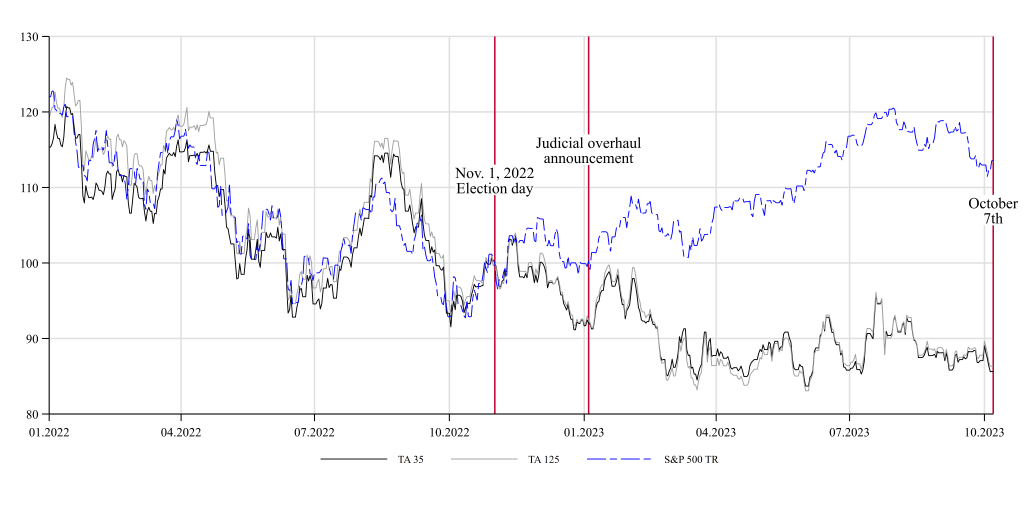
In early January 2023, Israel’s new governing coalition announced a plan for a judicial overhaul that would fundamentally weaken the power of the judiciary, the only meaningful check to the power of the executive branch in Israel. This paper describes the potential economic consequences of the judicial overhaul. We first discuss the extensive economic literature on institutions and their importance to economic development. Next, we use a large panel of countries to estimate the relationship between measures of institutional quality and four measures of economic development (GDP per capita, investment, innovation, and corruption). We use these estimates and the degradation of institutional quality in Hungary and Poland, two countries that experienced democratic backsliding, to forecast the potential long-run damage to the Israeli economy. Our calculations suggest that the judicial overhaul would have a dramatic negative impact on the Israeli economy. The estimated decline ranges from 9 percent in the most optimistic case to 45 percent in the most pessimistic one, both relative to an alternative scenario in which the judicial overhaul is abandoned. Finally, we describe the short-run negative effects of the judicial overhaul, particularly to the value of Israel’s currency, financial assets and to the high tech sector.

Migrant Self-Selection
Anthropometric Evidence from the Mass Migration of Italians to the United States, 1907–1925
Yannay Spitzer and Ariell Zimran
Journal of Development Economics (2018)
abstract
We study migrant selection using the rich data generated by the migration of Italians to the US between 1907 and 1925. Comparing migrants’ heights to the height distributions of their birth cohorts in their provinces of origin produces a measure of selection that is exogenous to migration, representative, and generated by almost unrestricted migration. The Italian migration was negatively selected at the national level, but positively selected at the local level. Selection varied systematically within Italy, with more positive local selection from shorter and poorer provinces. Selection was more negative among individuals with stronger connections in the United States and became more positive after imposition of the literacy test in 1917. These results highlight the importance of measuring selection at the local level to fully understanding the composition of migrant flows, shed light on the potential impacts of screening policies, and support theories that relate networks to more negative selection.
Working Papers
Pogroms, Networks, and Migration
The Jewish Migration from the Russian Empire to the United States, 1881–1914
Yannay Spitzer
abstract
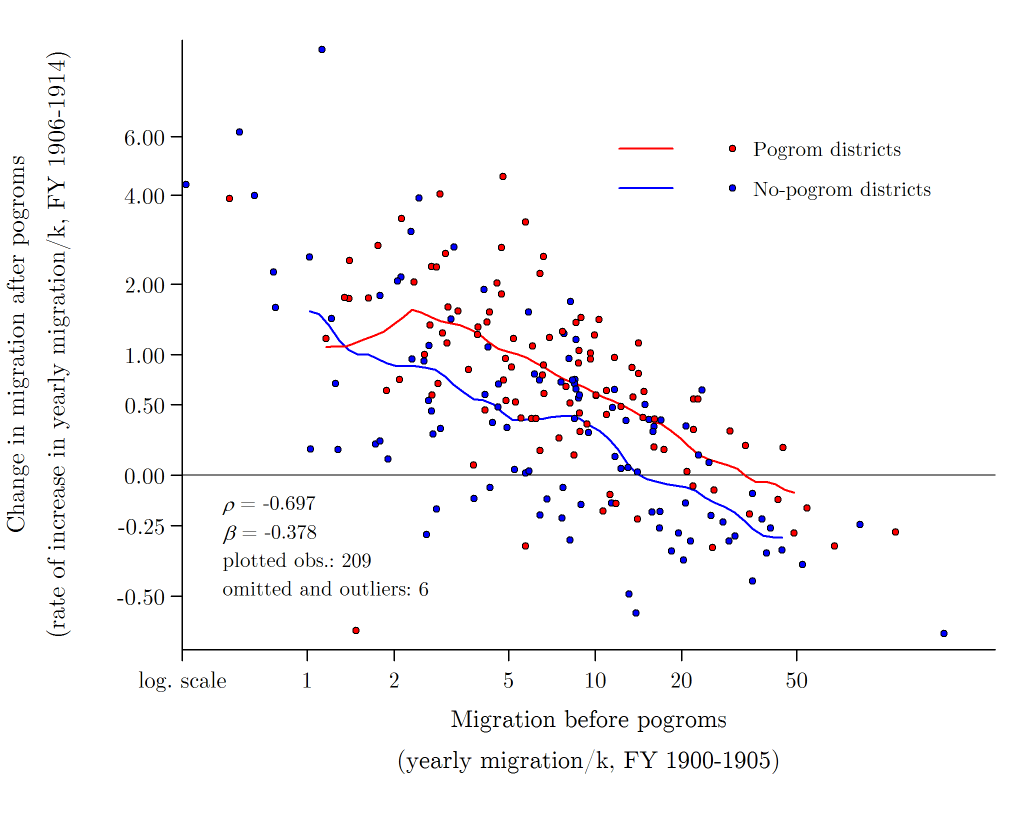
The mass migration of Jews from the Russian Empire to the US is commonly believed to have been caused by two waves of pogroms (1881-1882 and 1903-1906). Historians have recently questioned this view, but little quantitative evidence exists to support or refute it. To examine this view, I construct a data set that links hundreds of thousands of Jewish immigrants (1900-1914) and almost 1,500 Jewish hometown-based associations (1861-1920) to their places of origin, and geo-locate hundreds of pogroms. I find no evidence that the Jewish migration was initiated by the first wave of pogroms; instead, subsequent migration continued along a pre-existing spatial trend and originated from districts that did not experience violence. The second wave of pogroms, however, did meaningfully increase the rate of migration from affected districts. I interpret these findings as evidence that although both economic conditions and persecution were underlying motives for migration, neither explain the evolution of the Jewish migration across time and space. Instead, its main patterns were primarily shaped by a gradual process of spatial diffusion of social migration networks across the Pale of Settlement. This conclusion supports the Diffusion Hypothesis as an explanation for the delayed migration from the European Periphery during the Age of Mass Migration.
Like an Ink Blot on Paper
Testing the Diffusion Hypothesis of Mass Migration, Italy 1876–1920
Yannay Spitzer and Ariell Zimran
abstract
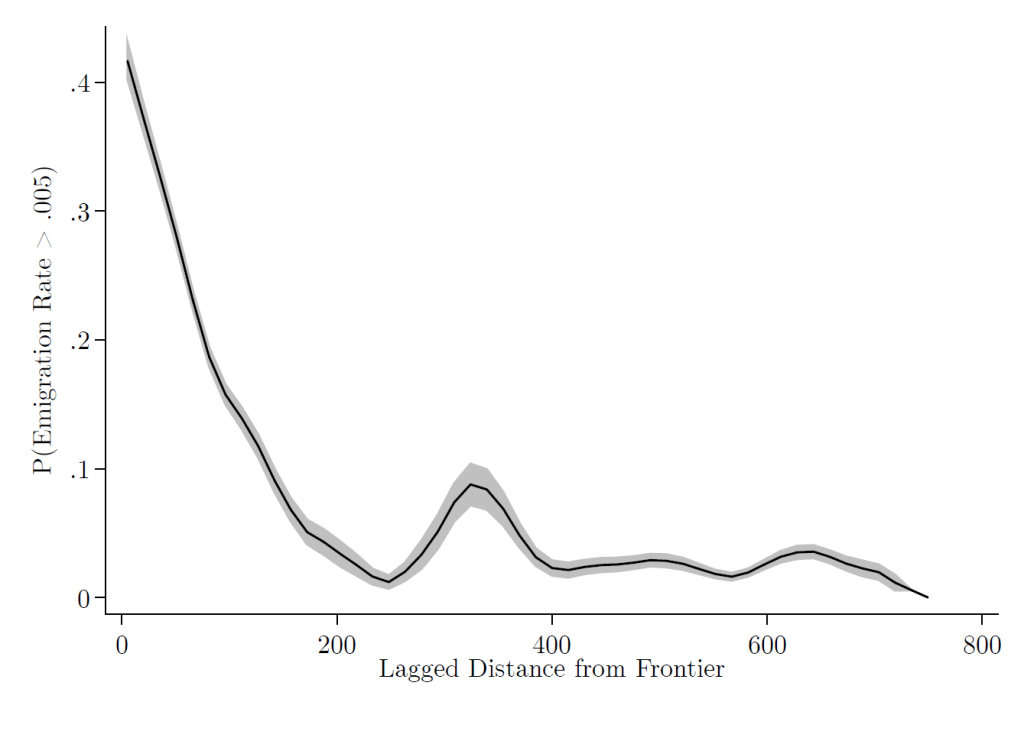
To explain the evolution of mass migration from Italy (1876-1920), we introduce the diffusion hypothesis, which augments traditional models of migration by allowing the spatial diffusion of migration over social networks in the country of origin. We test and validate the predictions of this theory using a new and comprehensive municipality- and district-level panel of emigration data over four decades. Italian migration began in a few separate epicenters from which it expanded gradually over time in an orderly spatial movement that dominated local push factors. While the main patterns that we document are parsimoniously explained by the diffusion hypothesis, they are difficult to rationalize by alternative theories. Confirming the diffusion hypothesis in the Italian case suggests that networks may be far more important than is commonly understood in shaping other movements of mass migration and may shape them in ways that have not previously been understood.

Pale in Comparison
Jews as a Rural Service Minority
Yannay Spitzer
abstract
Jews have been characterized as a quintessentially urban minority in almost every environment in which they had lived over the past millennium. This paper offers an alternative view in regards to the Jews of the Pale of Settlement around the turn of the twentieth century, the majority of world Jewry at the time. Using data from the 1897 Russian census, I show that they are best understood as a rural service minority: They specialized in countryside commerce, rather than in urban occupations, and were not disproportionately attracted to urban environments. Congestion effects in this niche caused their nearly uniform dispersion across space.
The Dynamics of Mass Migration:
Estimating the Effects of Income on Migration in a Dynamic Model of Discrete Choice with Diffusion
Yannay Spitzer
abstract
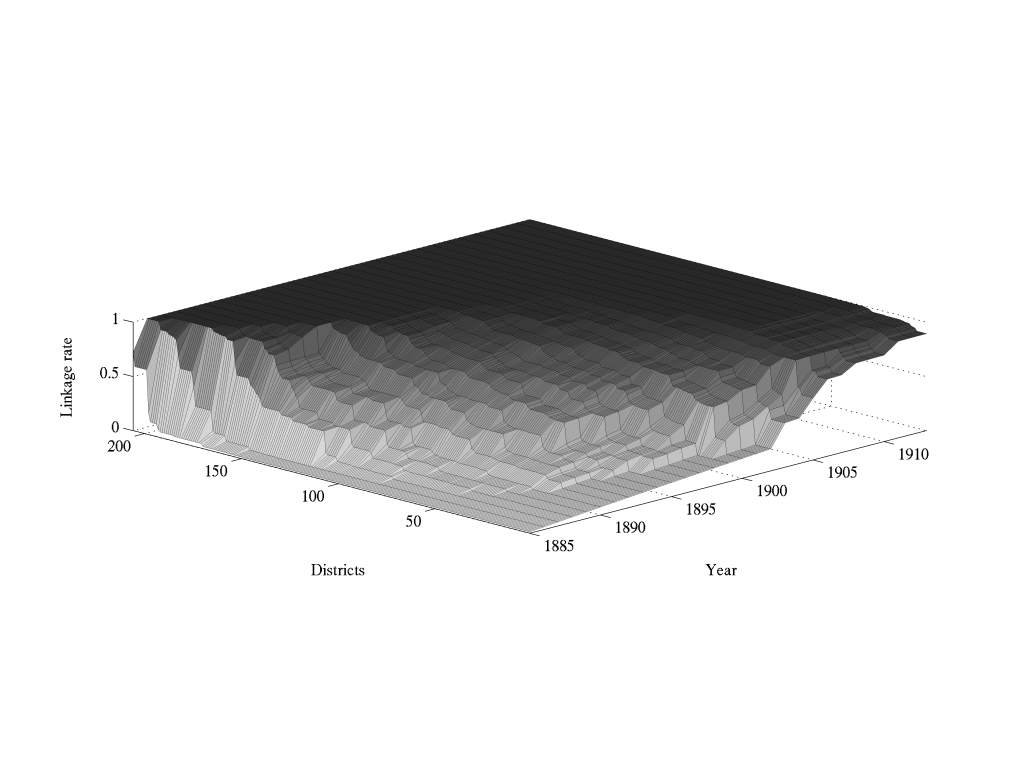
During the period 1881-1914, approximately 1.5 million Jews immigrated to the US from the Pale of Settlement in the Russian Empire. The data generated by this event can help explain the puzzling pattern of transatlantic mass migration: while time-series evidence shows that levels of migration were very volatile and highly sensitive to business-cycle fluctuations, there is little cross-sectional evidence for a systematic effect of income on migration—poorer countries did not always send more emigrants than wealthier countries. I address this using a unique data set, linking Ellis Island arrival records and incorporation of hometown-based associations of Russian Jews to information on their places of origin from the 1897 Russian census and from Russian yearbooks. Using a dynamic model of discrete choice with unobserved heterogeneity and an underlying diffusion process, I estimate the short-run effect of income shocks on migration, and show how the long-term effect of income levels could, in principle, be identified. I find that the sensitivity of migration to business cycles can be largely attributed to individuals optimally timing their migration—temporary shocks to migration were offset in the long run by delayed migration. Finally, I provide evidence affirming the disputed diffusionist view, that the entry of the European periphery to mass migration was delayed for decades due to the time required for migration networks to diffuse across the continent.
Selected Work in Progress
Entrepreneurship and Communal Tax Liability
The Political Economy of the Early Modern Jewish-Polish Symbiosis
Yannay Spitzer
abstract
During the Early Modern period, the Polish-Lithuanian Commonwealth became the demographic center of world Jewry. Jews were invited by kings and magnates to occupy certain economic niches within the Polish Second Serfdom economy. Over time, they developed a long-term symbiotic relationship with their hosts as service providers within the manorial economy, while enjoying unprecedented economic, political, and legal liberties and privileges. The epitome of this demographic, economic, and political golden age was the Council of the Four Lands (1580-1764), an autonomous national representative body whose primary role was administering the self-taxation of the entire Jewish population of Poland.
Why was the Polish elite so economically and politically hospitable to Jews? Why were Jews preferred over other available groups for their designated economic roles? Why was this virtuous arrangement tenable in the Polish-Lithuanian Commonwealth for half a millennium, while similar attempts in Western and Central Europe were far more limited and often collapsed? I argue that existing explanations are incomplete, and propose a new explanation that is grounded in a theory of efficient taxation in a pre-modern economy and on the historical evidence on the unique institutional arrangement of the Early Modern Eastern European Jewish community.
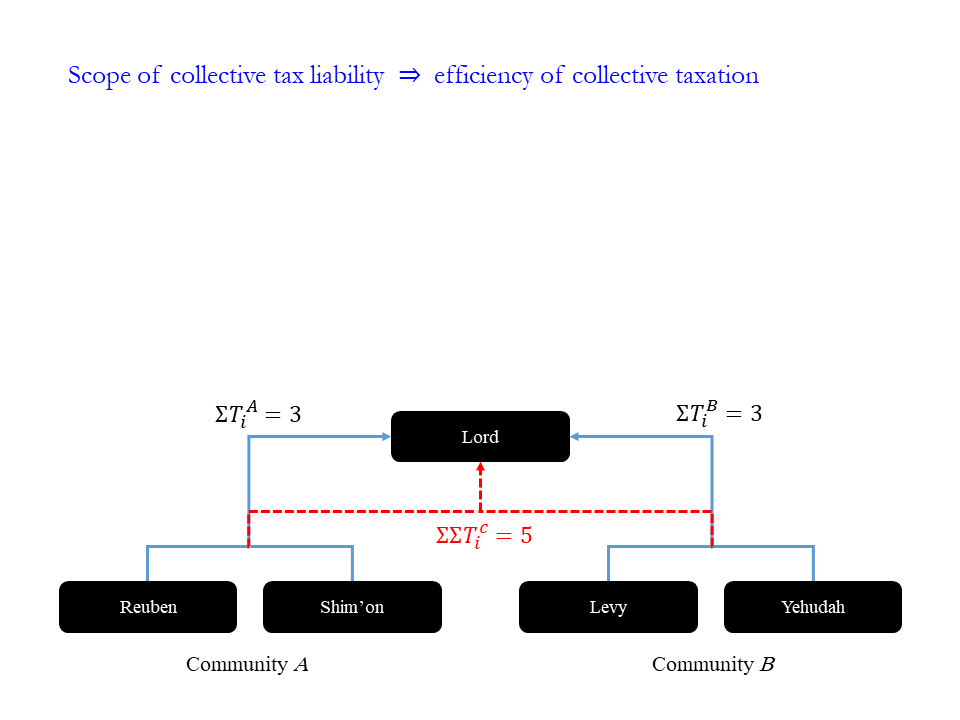
Relative to agriculture and manufacturing, income generated from entrepreneurial pursuits is harder to observe by the ruler, and therefore harder to efficiently tax directly. In the institutional and political context of Early Modern Poland, the most efficient method to tax such economic activities was through communal taxation at the widest possible scope. Jews stood out from other groups because their communal institutions had developed during the Middle- and late Middle Ages to support a superior mechanism of wide-scope internal communal taxation and external communal tax liability, and because they could not pose a political threat despite the extensive autonomy required by this arrangement. Thus, I explain the uniqueness of the Jewish-Polish symbiosis as a result of the surplus that was generated due to the ability to impose and implement communal taxation at the regional and national levels on an entire ethnic community that specialized, and often fully dominated, the entrepreneurial sector of the economy.
Gambling or America:
The First Wave of Migration to the Americas, 1492-1540
Leticia Arroyo Abad, José-Antonio Espín-Sánchez, Yannay Spitzer, and Ariell Zimran
abstract
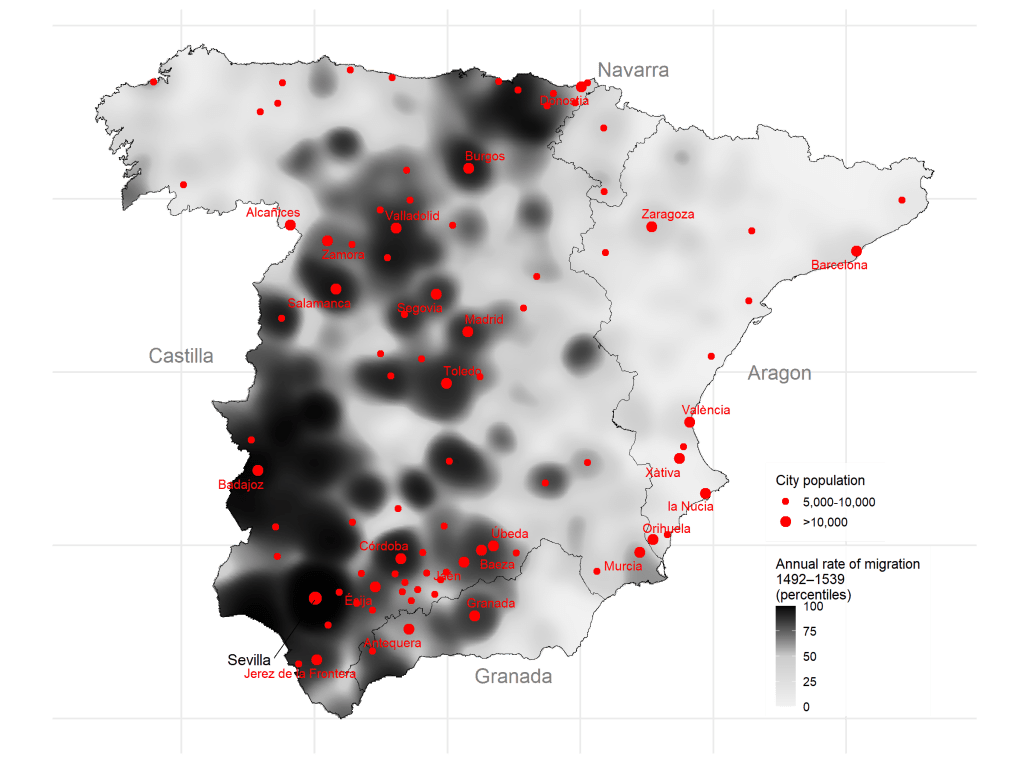
Columbus’s first expedition inaugurated one of the most important migrations in history. We study the patterns of the first transatlantic migration from Spain to the Americas (1492-1540) using a new database of individual-level migration records from archival and secondary sources combined with 16th century municipality-level Spanish population estimates.
 Yannay Spitzer