This is an English Translation of an op-ed published on Ha'Aretz as היו פגמים בדו"ח על רעב בעזה, אבל (There were faults in the Gaza Famine report, but; Oct. 15, 2026).
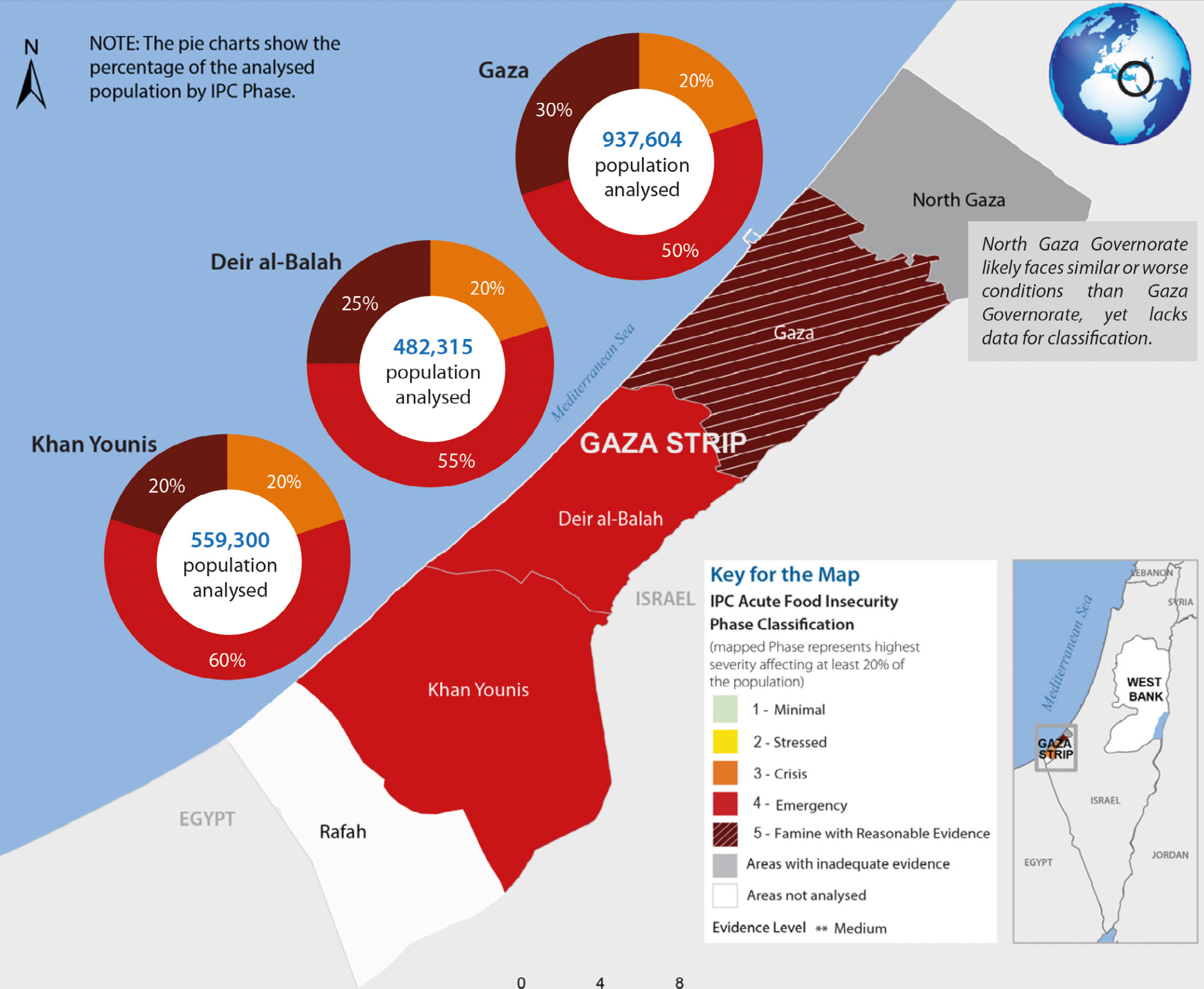
The Integrated Food Security Phase Classification (IPC) is an international framework for classifying the severity of food crises, established in the early 2000s. One of its core principles is the use of uniform and transparent standards designed, under conditions of incomplete information, to balance the risk of dangerous overcaution against the risk of erosion of credibility caused by false alarms. Crises are classified according to a detailed set of guidelines built on extensive experience from past emergencies and designed to function even when reliable data are difficult to collect. To date, the IPC has assigned its most severe classification—IPC Phase 5, Famine—only in a handful of crises, in Somalia, South Sudan, and Sudan.
In a report published on August 22, 2025, the IPC’s Famine Review Committee confirmed that Famine was occurring in Gaza Governorate, including Gaza City. The finding covered a period of roughly six weeks, beginning in early July. The report also projected that the famine would worsen and spread to additional areas. Israel thereby stood accused of having committed one of the gravest crimes imaginable.
Famine is a process in which food deprivation leads to widespread acute malnutrition, particularly among children, and acute malnutrition in turn leads to mass mortality. These deaths do not necessarily result directly from malnutrition; more often, they are an indirect consequence of it, as weakened immune systems interact with deteriorating sanitation and the spread of infectious disease. To classify an area as being in Famine, the IPC requires evidence that three indicators—food insecurity, the prevalence of acute malnutrition among children, and mortality—have crossed well-defined thresholds.
In the case of Gaza, the report settled for the lower evidentiary standard of “Famine with reasonable evidence,” rather than “Famine with solid evidence.” Under this standard, it was sufficient to have direct evidence for two of the three indicators and to rely on an indirect inference for the third—in this case, mortality.
As for the finding that food insecurity had reached a level that met the Famine threshold, there is little dispute. The rise in the prices of basic foodstuffs was indeed without documented historical precedent. But a critical reading of the report reveals serious flaws in the findings that either the prevalence of acute malnutrition or mortality rates had crossed the thresholds required for a Famine classification.
The finding that the prevalence of acute malnutrition had crossed the Famine threshold relied on an alternative measure to the standard one, because of the challenges of collecting data during active conflict. This was an understandable choice, and the alternative measure is accepted under IPC guidelines. But the IPC itself has acknowledged that the calibration of its threshold lacks sufficient scientific basis. In addition, the justification required to support the validity of that threshold in the report itself was flawed. A review of the literature on which the report relied suggests that the threshold should have been substantially higher, and that the measured prevalence of acute malnutrition was not close to crossing it.
Moreover, in direct conflict with the guidelines, the samples were non-random. The measurements were instead taken from children whose parents chose to bring them to health centers and medical points for vaccinations, medical treatment, or even programs for the prevention and treatment of malnutrition. There is strong reason to suspect that, as a result, the prevalence of acute malnutrition among children in the sample was substantially higher than among children in the population as a whole. Reinforcing this concern, several large samples displayed anomalies that are difficult to explain otherwise.
Only in December 2025 did the IPC publish an accompanying document that, for the first time, offered an expert judgment that the non-random sampling had not biased the malnutrition estimates. But the reasoning was cursory and was not supported by quantitative evidence, even though such evidence could readily have been obtained. Taken together, this series of flaws leads to the conclusion that the IPC erred in its August 2025 finding that the prevalence of acute malnutrition among children in Gaza Governorate had reached Famine levels.
Even more troubling was the quality of the evidence underlying the third finding: that mortality rates, too, had crossed the Famine threshold. Because only “reasonable” evidence was required for a Famine classification, an indirect inference was sufficient to support this finding. Yet the data cited in support were almost entirely irrelevant, and the reasoning in the report was again superficial and devoid of substantive validity.
The forecast that the famine would rapidly worsen and spread was equally flawed. By late July 2025, Israel had sharply changed its policy on the entry of essential supplies into Gaza. This shift came frustratingly late, but it preceded the publication of the report by about a month. Although the humanitarian situation in Gaza remained dire in the weeks that followed, food availability improved rapidly, and the crisis appeared to be easing. According to data presented in the report itself, the rate at which food entered Gaza had tripled from June to mid-August. Data from the Gaza Chamber of Commerce showed that the price of flour had fallen by about 90 percent from the peak of the crisis by mid-August. Yet the forecast disregarded these signs of improvement and instead projected that the pace of deterioration would accelerate even further.
After the report was published, researchers indeed identified many of these flaws, which had not characterized earlier IPC reports on food crises elsewhere. Some of these findings were presented in a response document issued by Israel’s Ministry of Foreign Affairs and the IDF’s COGAT, but few in the international community or the global media bothered to examine the merits of its claims. The IPC’s response combined substantive replies to weaker points of criticism with evasion and, at times, admissions of faults while denying their significance.
In early October 2026, Gaza’s Ministry of Health published a comprehensive update to its 2025 mortality data, all but closing the case on the proposition that Gaza had experienced famine-level mortality, even locally and for as little as a single month. In fact, the data indicate that mortality from non-violent causes over the course of the year was not substantially higher than before the war. There was no unusual mortality among children, and infant mortality was only slightly above normal.
The data are not final and may be overly optimistic. They undoubtedly omit many deaths that were never registered and may never be. But after a prolonged, if partial, ceasefire, during which registration improved, and given the incentives facing both families and the authorities to complete the records, the likelihood that missing data would alter the overall picture seems remote. Moreover, the existing records show no evidence of one of the hallmarks of famine mortality: a sharp rise in the share of child deaths among all deaths. Even if such mortality had been confined to Gaza Governorate for only a single month, it should have been apparent.
How could the prevalence of acute malnutrition and mortality rates have fallen so far short of Famine levels despite the severe food deprivation? If this was indeed the case, the answer lies in the fact that acute malnutrition and mortality are not immediate consequences of an acute shortage of food. Food crises typically unfold alongside displacement, systemic collapse, and poor sanitation. A population is even more vulnerable when most people are unvaccinated and uninformed, and when the share of trained medical professionals is low.
Most deaths do not result directly from malnutrition, but from the increased spread of disease among children, the elderly, and other vulnerable adults whose immune systems are weakened by malnutrition. No one can survive indefinitely on a severe and sustained caloric deficit. But prior vaccination, efficient distribution of the food that is available, targeted treatment of malnourished children, adequate sanitation, and medical care can delay a rapid descent into mass mortality.
Despite the destruction of its infrastructure, Gaza was no Somalia or Sudan. The share of medical professionals in the population is closer to levels found in Western countries. Its population is relatively well educated and vaccinated. Throughout the war, international aid organizations remained extensively active in Gaza, distributing food and providing medical care, public-health services, and community support—including the prevention and treatment of malnutrition. Unlike food crises that developed into Famine in recent decades, Gaza had a protective barrier that slowed the progression from food deprivation to widespread malnutrition and mass mortality.
Yet Israel cannot wash its hands of what happened. The most charitable interpretation of its conduct is that it behaved with criminal recklessness. For two and a half months in the spring of 2025, it prevented all food from entering Gaza. Aid organizations’ food stocks inside the Gaza Strip were initially full, but Israel had effectively threatened the population with starvation, while those reserves were rapidly depleted. On May 19, 2025, food was again allowed to enter, but the quantities were below the minimum flow needed to sustain the population, and the way food was brought in and made available was chaotic and deadly. The effective food-distribution network operated by aid organizations nearly collapsed due to widespread looting. For two more months, food security in Gaza continued to deteriorate, until in July 2025 one of the three Famine thresholds was likely crossed, as I warned at the time.
At the same time, Gaza’s sanitation system was heading toward collapse as diesel stocks dwindled; fuel deliveries resumed only gradually in early July. As a result, water distribution by tanker, sewage pumping, and garbage collection were severely disrupted. Conditions were ripe for an outbreak of mass disease. Had the shortages of food and fuel continued much longer, it is difficult to imagine that the other two thresholds—widespread acute malnutrition and mass mortality—would not also have been crossed, tipping Gaza into actual Famine. As noted, only in late July did a policy shift begin to avert the food crisis, but by then it was too late for Israel to escape the blame for famine.
Israel may, with some justification, complain about experts who erred and continue to deny it, or about an uneven global playing field in which their judgments go unquestioned. But it would have been far wiser to anticipate this quagmire and avoid the unnecessary disgrace altogether.


Leave a Reply